
Money essentially obtains its value from it’s ability to perform as a reliable ledger system. The better the ledger system is the more valuable that form of money will be. An ideal form of money would be one where the general ledger system could not really be tampered with.
This cryptographic ledger is a continuous record of settled transactions and ultimately creates a long list of blocks known simply as the blockchain. Unlike other forms of money, the blockchain or general ledger system is public and every transaction made between two Bitcoin wallets can be viewed at any point on the network.
While the transactions themselves are publicly visible the identities of the parties involved are private.
Here is a continuously updated list of Bitcoin transactions
Whenever a new block of Bitcoin transactions is created this new block is added to the blockchain. A constantly updated copy of each block is given to everyone participating allowing everyone to know what is going on.
The blockchain that Bitcoin is based on is exactly that: a general ledger system that is nearly impossible to tamper with.
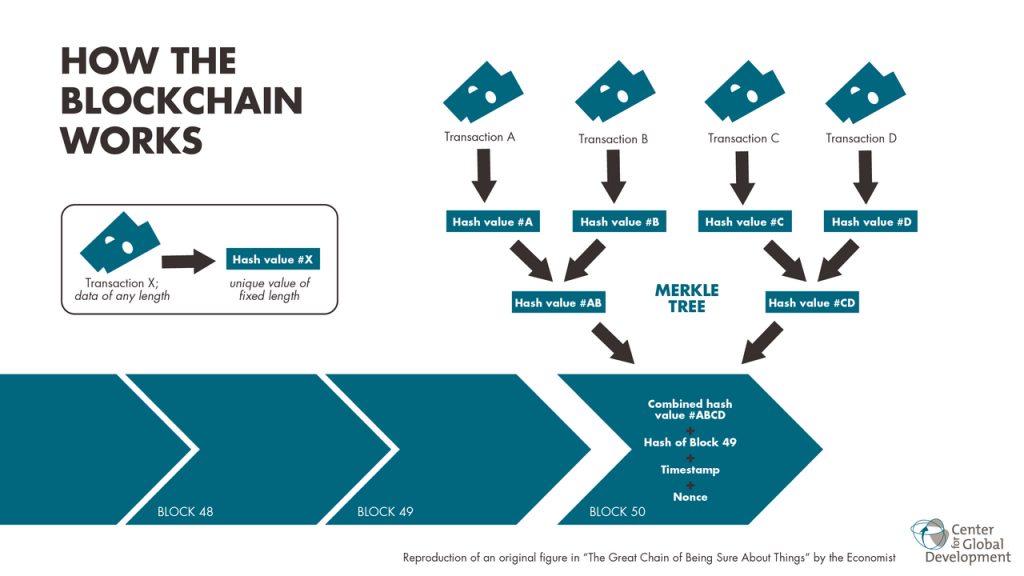
When a new block of transactions is created, miners take the information in the block and apply a mathematical formula. The application of this formula turns the block into a far shorter, seemingly non-sensical sequence of 64 letters and numbers known as a hash.

No matter how much data is being condensed, whether it is a single sentence or all of the information contained within the library of congress, a Bitcoin hash will always be 64 numbers of letters. Once the hash is created it is stored along with the block at the end of the blockchain.
This is an example of a Bitcoin hash: (well actually it’s one of my own personal Bitcoin wallet address). If you wish to make donation to the upkeep of this site.
1FBTpUNJhHEmzeJiF9K8TF6ABjbPhjJdp8 [ADD YOUR OWN WALLET HERE]
Bitcoin users send Bitcoin to each other over the Bitcoin network all of the time but in order to accurately keep track of who paid what to Who an incorruptible ledger needs to be kept. Bitcoin deals with this by gathering all of the transactions made during a set period of time into a cryptographic ledger, or block
Every hash produced is exactly 64 characters and completely unique. Changing just a single character in a Bitcoin block changes the hash completely. The data contained within a block is not the only data used to generate a hash. One piece of data that is used is the hash of the last block stored in the blockchain.
This process of creating new hashes by using the hash of the block before it means that if any block were tampered with and was not legitimate, everyone would know.